Jiu jitsu is physical problem-solving under pressure, and that combination trains your mind as much as your body.
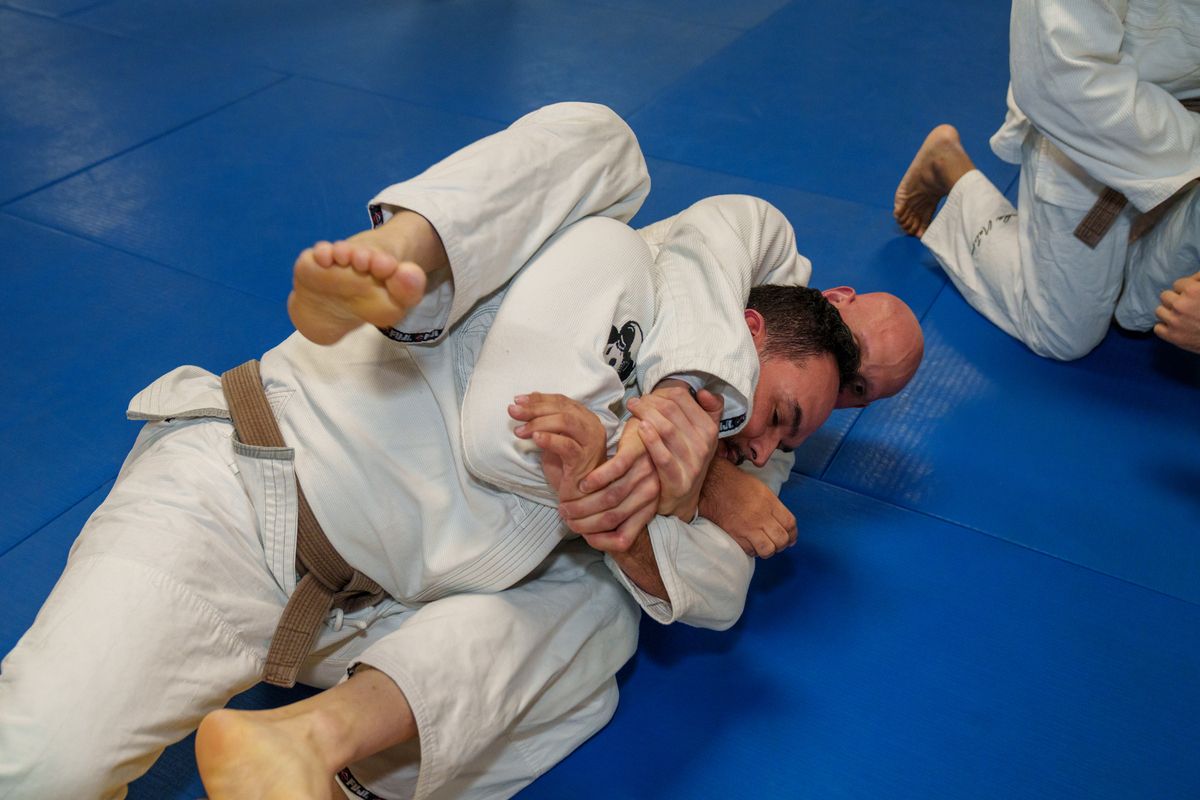
Jiu jitsu looks like a grappling art from the outside, but what you feel on the mat is closer to a moving puzzle that demands your full attention. You have to notice tiny shifts in balance, make decisions quickly, and stay calm when your heart rate spikes. That mix is exactly why so many adults end up talking about mental benefits even more than the physical ones.
Here in Bethlehem, PA, a lot of us juggle work demands, family schedules, and the constant background hum of stress that never fully turns off. Our goal in training is simple: give you a structured practice that sharpens focus and builds mental strength you can actually use on a Monday morning, not just during class.
Research lines up with what we see every week. In one large survey, 87.6 percent of adult practitioners reported improved confidence, 87.5 percent reported reduced anxiety, 81.3 percent reported enhanced mental flexibility, and 96.9 percent reported better mood. Those numbers matter because they describe daily life, not just athletic performance.
Why Jiu jitsu builds focus faster than you expect
Focus improves in Jiu jitsu because distraction has a cost you can feel immediately. If your attention wanders for two seconds, position changes, grips slip, and the moment is gone. That instant feedback trains you to return to the present without making it a big dramatic event. You just reset, breathe, and re-engage.
Unlike workouts where you can mentally drift and still finish a set, grappling demands real-time processing. You are tracking posture, pressure, timing, and leverage while also staying aware of safety and control. Over time, your attention span stretches because you practice sustained concentration in short, repeatable rounds.
We also structure classes to reinforce this. Drilling gives you repetition with clear objectives, and live training adds unpredictability. The result is a practical kind of focus that carries over into meetings, studying, parenting, and anything that requires calm attention.
The attention loop: breathe, notice, decide, act
A simple way to understand focus in Jiu jitsu is as a loop you repeat constantly. You breathe to stay steady, notice what is happening, decide on a response, and act. When the response fails, you do not freeze. You adjust and run the loop again.
That loop is a core mental skill. It keeps you from spiraling into frustration, and it stops the mind from racing ahead into what-if thinking. Many students tell us that, after a few months, they start using the same loop in everyday stress: slow breath, observe facts, choose the next step, move.
Mental strength is trained, not wished into existence
Mental strength is not just toughness. In training, we define it as the ability to stay effective when conditions are uncomfortable, uncertain, or tiring. Jiu jitsu gives you a safe place to practice that repeatedly, with partners and instructors guiding the intensity so it stays productive.
You learn to tolerate pressure without panicking, and you learn to stay solution-focused instead of emotionally reactive. That matters because life pressure is rarely a single big event. More often it is a steady, low-grade grind, and the skill is staying steady inside it.
Studies comparing belt levels suggest long-term training builds deeper resilience. Black belts show higher mental strength, grit, self-efficacy, self-control, and life satisfaction compared to white belts, along with fewer mental health disorders. You do not need to be advanced to benefit, but the pattern is motivating: the mental gains compound with consistency.
Confidence that comes from evidence, not hype
A big reason confidence improves is that Jiu jitsu is honest. When a technique works, you feel it. When it does not, you get clear feedback and can ask why. Over weeks, you collect evidence that you can learn hard things, stay composed, and solve problems under pressure.
That is the kind of confidence that holds up outside the gym. It is not a mood you hope for. It is a skill you build.
The flow state: why class can feel like moving meditation
People often describe a “flow” state in Jiu jitsu, where time feels different and the mind gets quiet. That is not mystical. It is what happens when the challenge is high enough to require full focus but structured enough to remain manageable.
During rolling, you cannot multitask. You cannot scroll, worry, or rehearse arguments in your head. You have one job: respond to what is happening now. For many adults, that is a rare mental break. It can feel like meditation, but with grips, frames, and timing as the anchor.
Research connects this mastery-focused mindset to lower rumination and improved well-being, similar to what structured mindfulness programs aim to develop. The difference is that our “mindfulness cue” is very practical: posture, breath, and pressure.
Stress and anxiety: learning to stay calm when it gets tight
One of the most useful lessons in Jiu jitsu is that you can be under pressure and still think. A tight position can trigger an instinct to tense up and rush. We coach the opposite: breathe, create space, build frames, and escape step by step. That physical practice becomes a mental template.
The survey data is striking here: 87.5 percent of adult practitioners report reduced anxiety. That does not mean training replaces professional care when you need it, but it does suggest Jiu jitsu is a powerful supportive practice for stress regulation.
We keep training progressive so you can build trust in your own ability to handle discomfort. You do not start with maximal intensity. You start with learning the movements, then controlled rounds, then gradually more complex situations. That progression is where mental strength grows without burning you out.
What you learn to do instead of panic
When you feel pressure in a bad spot, we teach you to do a few specific things consistently. Over time, these responses become automatic and spill into everyday life.
• Regulate your breathing so your body stops treating discomfort like danger
• Use small, practical goals like “recover guard” instead of “win right now”
• Stay curious about what is happening instead of labeling it as failure
• Reset quickly after mistakes, because the round keeps moving
• Communicate with training partners so intensity stays safe and productive
Decision-making under stress: the hidden skill of Bethlehem martial arts
Bethlehem martial arts are often talked about in terms of self-defense and fitness, and those benefits are real. But decision-making is the quieter advantage that adults notice later. Jiu jitsu forces you to make fast choices with incomplete information. Your partner moves, you respond, and you learn to accept that not every choice will be perfect.
That skill matters at work and at home. You get better at prioritizing, adapting, and staying composed when plans change. You also get better at separating what you can control from what you cannot, which is a surprisingly practical mental habit.
We train decision-making by teaching options rather than rigid scripts. You learn a primary response, then you learn what to do when it fails. The point is not memorizing moves. The point is building a mind that stays flexible.
How adult jiu jitsu in Bethlehem PA fits into real schedules
Adults are busy. We build the program so you can train consistently without needing to overhaul your whole life. Consistency is what drives mental changes, and research trends suggest sustained practice supports lasting psychological benefits, including PTSD symptom reduction in longitudinal studies with veterans.
If you can train two to three times per week, you give your brain regular reps of focus, pressure management, and social connection. If you can only train once some weeks, we still want you on the mat, because the habit matters. Your nervous system learns from repetition, not perfection.
A practical timeline for mental benefits
Everyone progresses differently, but we see a fairly common arc when adults commit to regular training. You do not need to overthink it. Show up, train, and let the process work.
1. Weeks 1 to 4: you feel the mental reset after class and start sleeping a bit better
2. Weeks 5 to 12: you notice clearer focus, fewer stress spikes, and more patience under pressure
3. Months 3 to 6: confidence becomes steadier because your skills start showing up reliably
4. Months 6 and beyond: resilience improves as hard rounds feel normal, not threatening
Community and mood: why training partners matter
Mood improvement is one of the most consistent reports in the research, with 96.9 percent noting better mood in that survey. Part of that is exercise, but part of it is belonging. Adult life can be isolating, even when you are surrounded by people. Training gives you regular, face-to-face connection with shared effort.
We keep the culture respectful and skill-focused. You get challenging rounds, but you also get teammates who want you to improve. That combination matters for mental strength because support and accountability make it easier to stay consistent, especially during stressful seasons.
It also helps that Jiu jitsu has clear progress markers. You can feel improvement in escapes, balance, timing, and composure even before any rank changes. Those small wins add up and can shift how you see yourself in daily life.
What to expect in your first classes
Starting can feel intimidating, but the first step is simpler than most people expect. We begin with fundamentals, safety, and controlled learning. You will spend time on posture, movement, and basic positions that create a strong foundation for everything else.
You do not need to be in shape before you start. Training is how you build fitness and confidence. You also do not need a perfect memory for techniques. We teach in layers, repeating core ideas until they become usable.
If your main goal is focus and mental strength, tell us. We can help you approach training in a way that supports those outcomes, including pacing intensity, tracking progress, and building a consistent weekly rhythm.
Take the Next Step
If you want a training routine that builds concentration, composure, and real-world resilience, our classes are designed for exactly that. At Inverted Gear Academy, we use Jiu jitsu as a structured practice for sharpening focus, managing stress, and developing mental strength that holds up in everyday life.
When you are ready, we will help you plug into the program at a pace that makes sense for your schedule, your body, and your goals. Inverted Gear Academy serves Bethlehem, PA with adult training that stays challenging, supportive, and practical from day one.
Move from reading to training and join an Adult Jiu-Jitsu class at Inverted Gear Academy today.