A good jiu jitsu class doesn’t just train your body, it quiets the mental noise and teaches you how to think clearly under pressure.
If your days in Bethlehem feel packed with deadlines, notifications, and constant context switching, you’re not alone, and you’re not “bad at focus.” Most of us are simply overloaded. That’s one reason we love jiu jitsu: it creates a rare environment where your attention naturally narrows to what matters right now.
In our classes, you don’t get rewarded for multitasking. You get rewarded for noticing details, breathing steadily, and making small decisions at the right time. Over time, that practice tends to show up outside the mats too: you feel less scattered, more present, and surprisingly calm even when life gets loud.
Research lines up with what we see every week. In one set of findings, about 75 percent of adult practitioners reported better concentration, 87.5 percent reported reduced anxiety, 81.3 percent reported improved mental flexibility, and 96.9 percent noted mood improvements. Those are big numbers, but the best part is that the pathway is very practical: training gives your brain a job, and your nervous system learns it can handle stress without spiraling.
Why jiu jitsu is a “focus practice” disguised as a workout
Jiu jitsu forces attention in a way that’s hard to replicate with typical exercise. When someone is actively trying to off-balance you, pass your guard, or set up a submission, your brain can’t drift into the usual background noise. You have to read pressure, track angles, and respond moment by moment.
That’s not just intensity for intensity’s sake. It’s structured problem-solving under constraints. You learn to prioritize: posture first, frames next, hips after that. Instead of chasing ten thoughts at once, you organize them. This is one reason people often leave class feeling mentally “clean,” even if physically tired.
From a mental clarity standpoint, we look at training as a loop:
1. You encounter a problem (a position, a grip, a timing issue).
2. You try a solution and get immediate feedback.
3. You adjust, simplify, and try again.
That loop trains focus because it rewards staying with the problem. No doom-scrolling, no passive consumption, just attention, action, and refinement.
Mental clarity benefits backed by real numbers
We like inspiration, but we also like evidence. Multiple studies and recent research trends from 2022 to 2024 describe Brazilian Jiu-Jitsu as a promising mental health supportive practice, including reductions in anxiety, improvements in mood, and stronger resilience over time. Advanced practitioners also tend to score higher on mental strength markers like self-efficacy, self-control, and life satisfaction, with fewer mental health disorders reported compared to lower ranks.
Here’s what matters in day-to-day life: mental clarity isn’t only “thinking positive.” It’s being able to choose your response instead of reacting on autopilot. Jiu jitsu teaches that skill directly because every round presents pressure, uncertainty, and the need for composure.
What “clarity” looks like after a few weeks of training
Mental clarity can sound abstract until you notice the small changes. We often hear students describe things like:
- Less mental chatter on the drive home from work
- Better patience in stressful conversations
- A calmer body response when something unexpected happens
- Improved ability to focus on one task at a time
- A mood lift that feels earned, not forced
These aren’t magical effects. They’re learned patterns: breathe, frame, move with purpose, reset when you’re stuck. It’s simple, but it’s not easy, and that’s why it works.
How jiu jitsu trains calm decision-making under pressure
If you want clearer thinking, you need reps in the exact moment your mind normally blanks. Jiu jitsu gives you those reps, safely and progressively, because the “pressure” is real but controlled. You learn to identify what’s urgent and what’s just uncomfortable.
A common early lesson is this: being pinned feels panicky until you understand structure. Once you build a few reliable escapes, your brain stops screaming and starts scanning for options. That shift, from panic to problem-solving, is the heart of mental clarity.
In practical terms, we coach decision-making like this:
- Recognize the position (where are you, what are the risks)
- Stabilize (posture, frames, breathing)
- Improve incrementally (hip escape, angle change, grip fighting)
- Commit to one plan and accept feedback
That last point matters. A foggy mind wants perfect certainty. A clear mind can choose a good option quickly and adjust if it fails.
Why Bethlehem professionals like training for focus
Bethlehem has a lot of people balancing demanding work with family life and a packed calendar. Whether your day is hands-on, desk-heavy, or a mix of both, the pattern is similar: your attention gets pulled in twenty directions. Training creates a single-direction hour where you can’t take your worries with you onto the mat. Not because you’re suppressing them, but because your body is busy learning.
This is where “Bethlehem martial arts” becomes more than a search term. For many locals, it’s a practical wellness strategy. A consistent schedule, a supportive room, and a skill-based practice can anchor your week. You show up a little stressed, you train, and you leave lighter, more organized upstairs.
The hidden mental skill: learning to relax while working hard
One of the most transferable skills in jiu jitsu is relaxed effort. Beginners often try to muscle everything, which spikes fatigue and anxiety. With coaching and time, you learn to conserve energy, breathe, and use technique. Your body stays engaged, but your mind doesn’t go into alarm mode.
That’s a mental clarity superpower, especially in high-pressure situations off the mats. You start noticing when you’re clenching through your day: jaw tight, shoulders up, shallow breathing. Training gives you a reference point for a better state.
A simple “mat-to-life” reset you can use today
We teach breath and posture constantly, because it changes outcomes fast. Here’s a quick reset we recommend:
- Inhale through your nose for a slow count of four
- Exhale for a slow count of six
- Drop your shoulders and unclench your hands
- Pick one next action, not five
It’s basically what you do when someone is applying steady pressure and you need to think. The funny thing is, it works in traffic and meetings too.
What to expect in our classes if you’re new
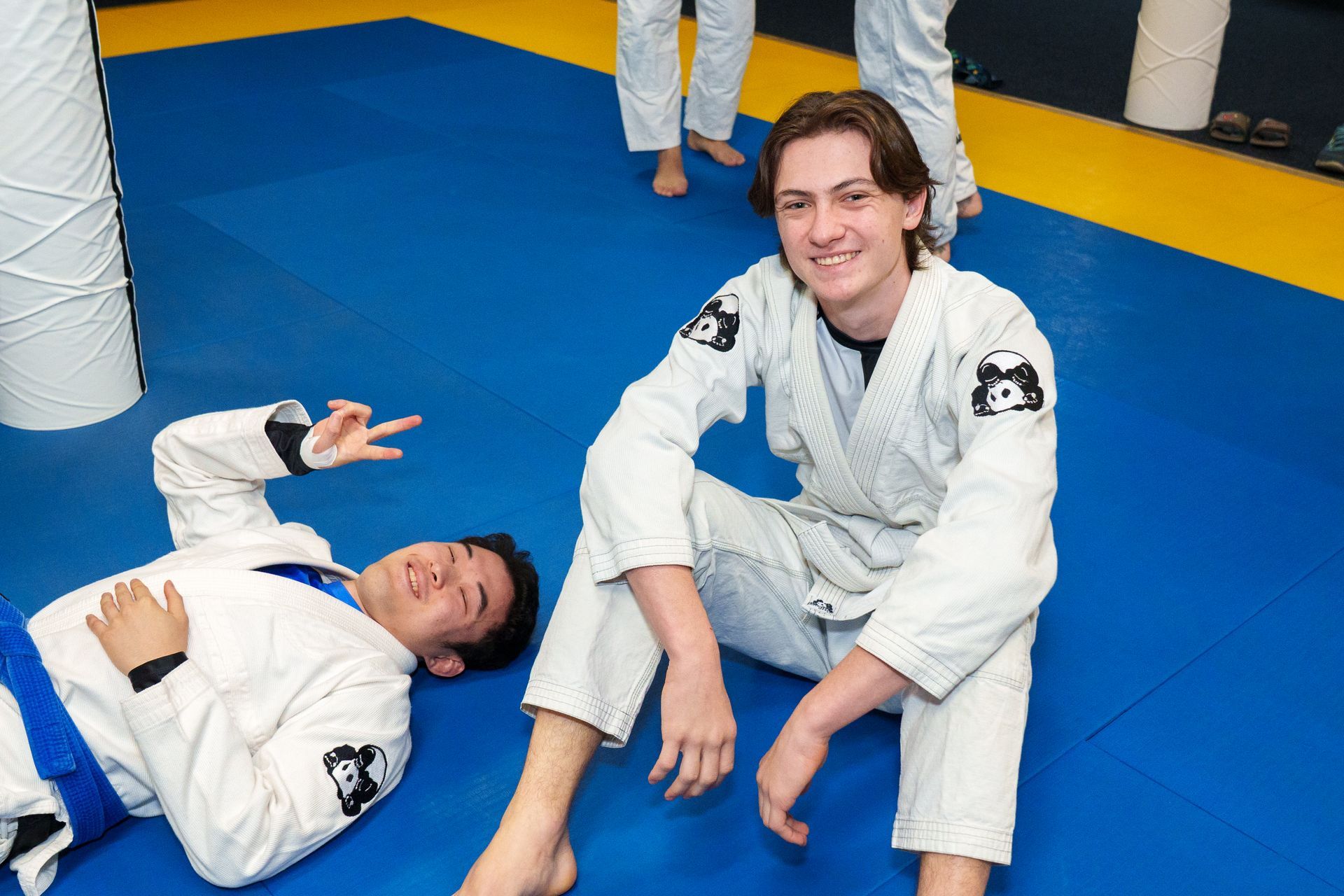
Starting jiu jitsu can feel intimidating, mostly because it’s unfamiliar. We keep the learning curve manageable by giving you structure and clear goals. You’ll learn positions, escapes, and basic submissions, but the bigger win is that you’ll learn how to learn, calmly, without getting overwhelmed.
A typical beginner-friendly class experience includes:
- A warmup that prepares your joints and breathing without burning you out
- Technique instruction with details that actually matter in live training
- Drilling, where you repeat the movement enough to make it real
- Controlled rounds that match your experience level
- A short wrap-up so you leave with one or two takeaways to focus on next time
You don’t need to be “in shape” to begin. You get in shape by showing up. And mentally, you don’t need to be fearless either. You just need enough curiosity to take the first step.
Building mental flexibility through progressive training
Mental clarity isn’t only about focusing on one thing. It’s also about switching strategies when reality changes. In jiu jitsu, the “right” move depends on timing, size differences, and what your partner is doing. That constant adjustment builds mental flexibility, which research suggests is one of the psychological benefits many practitioners report.
We train this progressively. Early on, you might learn one escape from side control. Later, you learn variations based on different grips and pressure. Eventually, you stop memorizing moves and start seeing patterns. That pattern recognition makes you faster, calmer, and more decisive.
This is also why experience matters. Studies show higher belts often report greater resilience and self-efficacy. That doesn’t mean you need years to benefit. It means the benefits stack, and the process keeps paying you back.
Using a simple routine to track your mental clarity gains
If you’re the kind of person who likes measurable progress, we recommend a quick training journal. Nothing fancy. After class, jot down:
- One technique you learned
- One moment you stayed calm under pressure
- One thing you’ll try differently next time
In a month, you’ll have proof that your mind is changing. You’ll also notice that you’re thinking more clearly in everyday situations, because you’ve been practicing clarity with resistance, not just wishing for it.
Jiu jitsu Bethlehem PA: what makes the training environment matter
When people search jiu jitsu Bethlehem PA, they’re often looking for more than a place to sweat. They want coaching that makes sense, partners who train safely, and a schedule that fits real life. The environment shapes your mental experience. If training feels chaotic, it can add stress. If training feels structured and respectful, it becomes a pressure relief valve.
We focus on clean fundamentals, progressive intensity, and a culture where you can ask questions without feeling awkward. That matters for mental clarity because learning requires safety, not ego. When you trust the room, your brain stops scanning for threats and starts absorbing information.
Ready to Begin
If you want a practice that strengthens your body while sharpening your attention, jiu jitsu is one of the most direct routes we know. You’ll train focus in real time, learn to relax under pressure, and build decision-making skills that carry into work, family life, and everything else that demands your best thinking.
We’ve designed our programs at Inverted Gear Academy to make those benefits accessible, whether you’re brand new or returning after time away. If you’re in Bethlehem and you’re ready for a clearer, steadier kind of confidence, we’d love to help you start.
Build stronger grappling skills and refine your technique by joining an Adult Jiu-Jitsu program at Inverted Gear Academy.