When your mind won’t slow down, the right kind of training gives you a reset you can actually feel.
Stress is sneaky. It shows up in your shoulders on the drive home, in your jaw while you scroll at night, and in that tired feeling you can’t quite sleep off. We see it every week with adults who want a workout, sure, but mostly want their brain to stop running a marathon at 10 pm. That is where jiu jitsu shines.
Unlike workouts where you can mentally check out, jiu jitsu asks you to be present. You have to solve a problem in real time with another person, in a controlled setting, with clear rules. The interesting part is what happens after class: your nervous system settles, your breathing is deeper, and the day’s noise gets quieter.
Here in Bethlehem, busy schedules and constant demands are normal. Our job is to give you a place to train hard, think clearly, and walk out lighter than you walked in, even if you were skeptical on the way in.
Why Jiu-Jitsu works when other stress fixes don’t stick
Most stress relief advice is passive: rest more, scroll less, breathe. Those things matter, but they can feel vague when you are carrying real pressure. Jiu jitsu is active stress relief. It gives your mind a single task, your body a safe outlet, and your emotions a way to discharge without pretending everything is fine.
Research backs up what we hear from students. In adult participants, 87.5 percent reported reduced anxiety and 96.9 percent reported improved mood with Brazilian Jiu-Jitsu practice. People also report confidence improvements around 87.6 percent, and sense of community is consistently reported at 100 percent. Those are big numbers, and they map to what makes training feel different: you are not doing it alone, and you are not guessing what to do next.
Stress also has a chemistry component. Physical exertion triggers endorphin release and helps regulate cortisol and adrenaline. Jiu jitsu does that, but it also adds decision-making under pressure, which is a very specific kind of mental workout that transfers to daily life.
The “moving meditation” effect: mindfulness you don’t have to force
A lot of adults struggle with sitting still and “being mindful.” If your mind is busy, traditional meditation can feel like another task to fail at. Jiu jitsu gives you mindfulness with guardrails, because the moment you drift, you get swept, pinned, or submitted. It is immediate feedback, and it is oddly calming.
During live training, your attention narrows to a few key details:
- Where your weight is
- How your breathing feels
- What grips you have and what grips you need
- Whether you are safe, or about to make a mistake
That focus is a break from work emails, family logistics, and the constant Bethlehem-to-everywhere commuting mindset. You are in your body. You are in the moment. It is not mystical. It is practical.
What happens in your body when stress drops after class
We like to explain stress relief in plain terms because it helps you trust the process. When you train, your heart rate rises, your lungs work, and your muscles fatigue. Your body does what it was built to do. Then, when class ends, your system shifts into recovery. That recovery is where many people feel the calm.
For stressed adults, the post-class effect often looks like:
- Better sleep that night, even if your day was chaotic
- Less muscle tension in the neck and shoulders
- A clearer appetite signal, not just stress-snacking
- A quieter inner monologue, at least for a while
This is also why consistency matters. A single class can help, but regular training builds a reliable pattern. A 2024 study found 92 percent of martial arts practitioners training twice weekly reported gains in resilience and focus. Twice a week is realistic for many adults, and it is enough to feel momentum.
Pressure training builds resilience without building aggression
One fear we hear, especially from professionals and parents, is that jiu jitsu might make someone more aggressive. In practice, the opposite tends to happen. Because you learn to stay calm while someone is applying pressure, your nervous system adapts. You learn to think instead of panic.
This matters for stress because panic and stress are close cousins. Your body does not always know the difference between a tough work meeting and being stuck under side control. In class, we teach you how to breathe, frame, escape, and improve position. That same skill set becomes emotional: pause, create space, solve the next step.
Longer-term studies have also highlighted sustained benefits for PTSD symptoms in veterans and first responders. That is especially relevant in our region, where many adults carry high-responsibility roles. Jiu jitsu is not therapy, and we do not pretend it is. But it can be a powerful support, because it builds self-efficacy, self-control, and a sense that you can handle hard things.
Why partner-based training helps your nervous system feel safe again
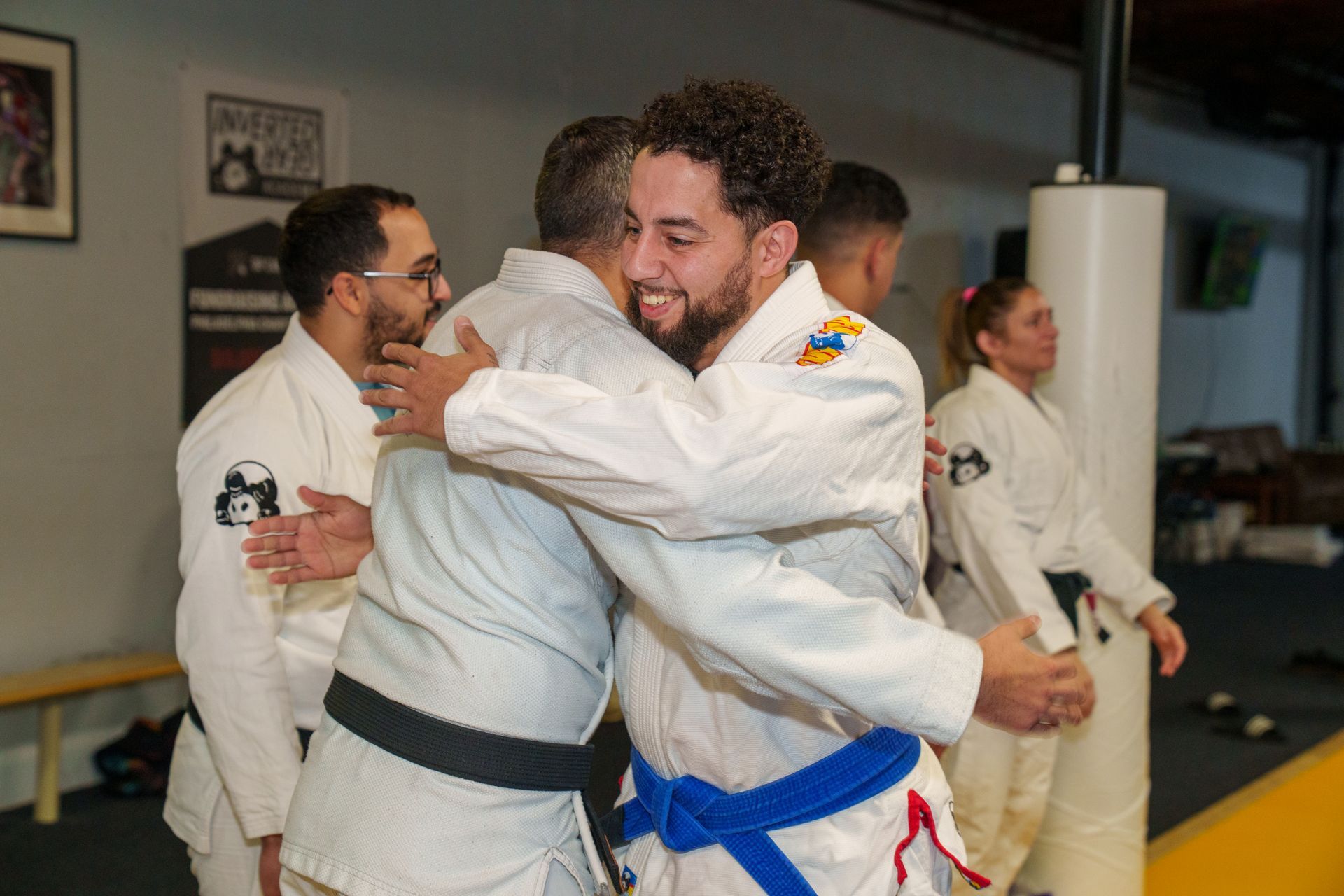
Stress isolates people. Even when you are around others, you can feel like you are carrying everything alone. Jiu jitsu is different because it is structured connection. You train with partners, you switch partners, you learn names, and you help each other improve. That community element is not fluff, and the data reflects it: sense of community reporting hits 100 percent in multiple surveys.
In class, you are not performing for an audience. You are practicing with teammates. You tap, reset, laugh a little, learn again. That rhythm is grounding.
For many adults, this becomes their healthiest social routine of the week. It is not networking. It is not small talk for the sake of small talk. It is shared effort, and it tends to make people feel human again.
What a typical class feels like for a stressed beginner
If you are looking for adult jiu jitsu in Bethlehem PA, the biggest hurdle is usually not fitness. It is walking in the door and not knowing what you are supposed to do with your hands, your feet, your nerves. We keep the first experience straightforward and structured.
A typical class flow usually includes a warmup that prepares your joints and breathing, technique instruction with clear steps, and drilling that lets you repeat the movement enough times to feel it click. Then we layer in controlled live rounds, matched appropriately, so you can practice without chaos.
Expect to feel clumsy at first. That is normal. But also expect something surprising: a lot of beginners feel calmer after the very first class. Not because everything is easy, but because your mind finally had one job.
How we make training safe, progressive, and sustainable
Stress relief only works if you can keep showing up. So we coach for longevity. That means technical progressions, smart intensity, and a culture of tapping early and often. Your goal is not to “win” practice. Your goal is to learn and leave with your body intact.
We also pay attention to the practical details that beginners worry about:
- You will learn how to roll safely and how to fall safely
- You will get guidance on pacing so you do not gas out in five minutes
- You will learn how to communicate with partners, including when to slow down
- You will learn what to do with injuries, soreness, and recovery days
If you are stressed, your recovery capacity can be lower. We account for that. We would rather have you train consistently than go too hard once and disappear for a month.
Stress relief you can measure: focus, mood, confidence, and sleep
The mental benefits of jiu jitsu are not just a vibe. They show up in daily life in ways you can actually track. Adults commonly report improved mood, better focus, and more confidence, and studies back those outcomes with high percentages.
Here are a few “real life” indicators you are getting the benefits:
- You handle a frustrating moment at work with less reactivity
- You fall asleep faster because your body feels used, not wired
- You ruminate less because you spent an hour practicing presence
- You feel more confident setting boundaries, because you practice control physically
- You notice your posture is better, which sounds small but changes everything
This is where Bethlehem martial arts training becomes more than fitness. It becomes a skill set for living under pressure.
How often should you train for mental health benefits?
We like simple plans that busy adults can follow. If your main goal is stress relief, consistency matters more than intensity. Two sessions per week is a strong baseline, and it aligns with the 2024 resilience and focus findings for twice-weekly martial arts practice. Three sessions per week can accelerate your learning and deepen the mental reset, as long as your schedule and recovery allow it.
If you are starting from zero, give yourself a ramp. Your first month is about building the habit and learning how to breathe and move without holding tension everywhere. After that, you can decide whether you want to add sessions.
Beginner tips that make Jiu-Jitsu feel calmer right away
These are the small things that change the experience fast. If you try them, you will feel the difference.
1. Breathe through your nose whenever you can, especially when you feel stuck
2. Tap early, reset, and treat tapping like information, not failure
3. Focus on survival first, then escapes, then control, then submissions
4. Ask one question after class, not ten, and let one concept settle
5. Train at a steady pace for your first few weeks so your body trusts the process
This is not about being tough. It is about building a stress response that does not run your life.
Take the Next Step
If you want a workout that clears your head and builds real resilience, our jiu jitsu program is designed to do exactly that, one class at a time. You get hard training, practical skill-building, and a team environment that makes it easier to keep showing up when life gets busy.
At Inverted Gear Academy in Bethlehem, we keep the process approachable for beginners while still giving experienced students the depth that makes jiu jitsu a lifelong practice. Use the class schedule on the website to pick a time that fits, and come in ready to learn, breathe, and leave with your stress turned down.
Ready to begin your martial arts journey? Start training in Brazilian Jiu-Jitsu at Inverted Gear Academy today.