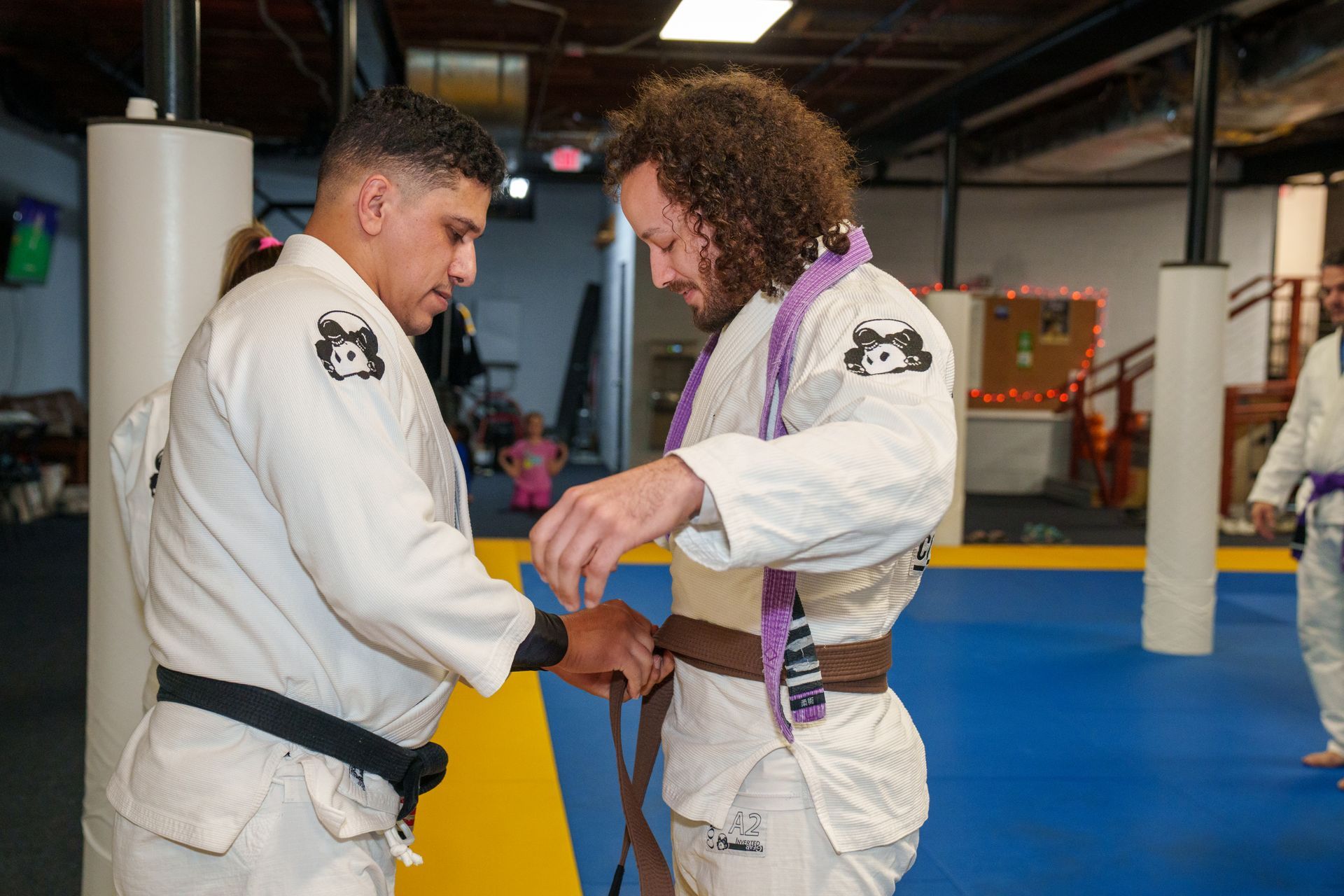
When your mind feels stuck on overdrive, the mats give you a reset button you can actually feel.
Stress in Bethlehem can look pretty normal on the outside: a packed workday, a commute that eats your free time, and a phone that never stops lighting up. But normal does not mean easy. We meet a lot of people who are doing everything right and still feel tense, distracted, or just worn down. That is exactly why we talk so much about Jiu jitsu as a practical stress tool, not just a hobby.
Jiu jitsu has a way of turning mental noise into something you can work with. You show up, you learn a skill, you practice it with a partner, and you leave with a calmer body and a clearer head. Research backs that up, too: large numbers of adult practitioners report reduced anxiety, better mood, and improved confidence, and higher belts often show measurable boosts in mental strength and self-control over time.
If you are looking for brazilian jiu jitsu in Bethlehem PA because you want to feel better day to day, our job is to make training approachable and sustainable. Stress relief is not a one-time trick. It is a habit you build.
Why stress hits Bethlehem residents in a very specific way
Bethlehem has a strong work ethic. Between healthcare, education, manufacturing, logistics, and service jobs across the Lehigh Valley, many schedules run early and end late. Even when you like your work, the pace adds up. We also see seasonal stress show up hard during Pennsylvania winters, when less sunlight and more time indoors can mess with sleep and mood.
On top of that, a lot of stress is quiet. It is not always a dramatic event. It is the slow drip of constant decision-making, constant responsibility, and that feeling that you are never fully caught up. When people describe it to us, it often sounds like this: “I cannot turn my brain off.” Jiu jitsu gives you a structured place to do exactly that, without needing to pretend life is not busy.
The science: what Jiu jitsu does to your nervous system
Stress is not only in your head. It is in your hormones, your breathing, your muscle tension, and your attention span. One reason Jiu jitsu works so well is that it hits multiple stress pathways at once.
Endorphins, cortisol, and the “post-class exhale”
Hard training reliably triggers endorphin release, which is part of why you can walk out of class feeling lighter, even if you worked. At the same time, consistent exercise is linked to lower baseline stress responses for many people. In practical terms, you may notice your shoulders drop and your jaw unclench after training, which is not poetic language, it is your nervous system shifting gears.
Jiu jitsu also teaches you to stay functional under pressure. You learn to breathe when you would normally tense up. You learn to problem-solve when you would normally panic. That skill transfer is real. It follows you into traffic, meetings, parenting, and all the little Bethlehem life moments where patience gets tested.
Mindfulness that does not feel like “doing mindfulness”
Some stress tools are great, but they can feel like one more chore. Jiu jitsu is different because focus is built into the activity. When you are trying to pass guard or escape a pin, you cannot also rehearse tomorrow’s to-do list. Your attention narrows naturally. That is mindfulness without the extra friction.
We also coach breath control during live rounds because your breathing sets the tone for your nervous system. Slow, steady breathing helps you think clearly and move efficiently. It is a performance skill, but it is also a calmness skill.
Why Jiu jitsu stress relief works for beginners, not just athletes
A common concern we hear is, “I am not in shape yet.” That is fine. You do not need to be “ready” to start. We build skills progressively, so your first classes can be about learning positions, movement patterns, and safety basics. Stress relief starts early because even light training can change your mood fast.
Studies have found that around 87.5 percent of adult practitioners report reduced anxiety and around 96.9 percent report improved mood, with confidence improvements reported at similarly high rates. Those are big numbers, and we think the reason is simple: training gives you an immediate sense of agency. You do something difficult, you learn something real, and you realize you can handle more than your brain was giving you credit for.
Also, you get out of your own head. Beginners often tell us their first surprise is how quickly class becomes the most “present” hour of their week. Not perfect, not magical, just present.
Bethlehem martial arts that builds calm through capability
Not all stress relief comes from quiet. Sometimes the best way to feel calmer is to feel more capable. Jiu jitsu is a skill-based form of Bethlehem martial arts training where technique beats brute force again and again. That matters for stress because helplessness is stressful. Progress is calming.
When you learn how to escape bad positions, you are practicing a mental script that says: “I can work my way out.” When you learn how to control someone without relying on strength, you are practicing patience and precision. Those are emotional skills, too, even if nobody calls them that out loud.
The confidence effect is not about ego
Confidence in Jiu jitsu usually shows up quietly. You stop catastrophizing. You stop assuming the worst. You become harder to rattle because you have experienced pressure in training and learned you can stay composed. Research even suggests higher belts show stronger self-efficacy, self-control, and life satisfaction than lower belts. We like that because it frames Jiu jitsu as a long game: you build a steadier you over time.
What a stress-busting class actually looks like
People sometimes imagine Jiu jitsu as nonstop sparring. Live training is part of it, but a well-run class balances learning, drilling, and controlled rounds so you can improve without feeling overwhelmed.
Most classes follow a rhythm that helps stress drop in stages:
- You arrive and your brain is still in “work mode,” maybe a little tense
- Warmups raise your heart rate and loosen stiff joints
- Technique gives you a clear problem to solve
- Drilling builds competence through repetition
- Sparring lets you apply skills with real feedback
- Cooldown and the walk to your car feels, honestly, quieter than when you arrived
That predictable arc is part of the benefit. Your body learns: this is a place where we work, breathe, and reset.
How we make training safe and realistic for busy adults
If you are a parent, a shift worker, or someone juggling a lot, safety and recovery matter. We coach control first. We also encourage you to train at an intensity you can recover from, especially early on. You will progress faster when your body feels good enough to come back consistently.
Here are a few habits we recommend for stress relief and longevity:
- Train two to three times per week if your schedule allows, because consistency matters more than intensity
- Hydrate and eat a real meal after class, since low fuel can feel like anxiety
- Track your mood before and after training for a couple weeks, just a quick note on your phone
- Tap early and often while learning, because smart training is calm training
- Focus on breathing during tough positions, especially when your instinct is to hold your breath
These are small things, but they add up. The goal is that Jiu jitsu becomes your anchor, not another source of pressure.
Jiu jitsu for PTSD, anxiety, and the heavier stuff
We are careful with big promises because mental health is personal. But the research trend is encouraging: studies from recent years describe Brazilian Jiu-Jitsu as a promising, still-understudied public health tool, including for PTSD symptom reduction and improved resilience. Veterans and first responders have been highlighted in the research, and longitudinal findings suggest benefits can be sustained with ongoing practice.
What we see on the mats matches the basic mechanism: training gives you structure, community, and a way to regulate your nervous system through controlled challenge. You practice staying present in discomfort. You practice recovering after hard rounds. And over time, that can change how you respond to stress outside the gym.
If you are working through anxiety or PTSD, we welcome you, and we also encourage you to bring your support system along, whether that is family, a clinician, or trusted friends. Jiu jitsu can be part of a bigger plan.
The community factor: why you feel better faster when you are not doing it alone
One reason solo workouts do not always stick is that stress makes motivation fragile. Community helps. In BJJ surveys, practitioners report a strong sense of community at extremely high rates, and we think that matters as much as the workout.
On the mats, you solve problems with partners, you learn from each other, and you get real-time feedback. You also laugh sometimes, usually when something goes sideways in a very human way. That lightness is not a distraction from training. It is part of why training helps your mood.
Community also creates accountability that does not feel harsh. People notice when you are back. People help you improve. And if you have had a rough day, you do not need a speech about it. You can just train.
A quick look at progression: beginner stress relief vs long-term resilience
Early stress relief is often immediate. You sweat, you focus, you breathe, you leave calmer. Long-term resilience is different. It is what happens when your identity shifts from “I am stressed” to “I handle stress.”
We tend to see progression in stages:
1. Weeks one to four: you feel better after class, and you start sleeping more deeply
2. Months two to six: your confidence grows because you can name positions and solve basic problems
3. Six months to a year: you notice more patience at work and at home, especially under pressure
4. Beyond that: you become harder to shake, because composure is now practiced, not accidental
That is one reason we love this art. Jiu jitsu is not only a workout. It is training for your attention, your breathing, and your ability to stay steady.
How to fit Jiu jitsu into a Bethlehem schedule without burning out
We design training to fit real life, not the other way around. Evening classes can work well for commuters, and consistent two-day or three-day routines usually outperform “whenever I can” plans. If you are new, we also suggest starting with a pace that feels almost too easy. It is better to leave one round early and come back tomorrow than to go all-out once and disappear for three weeks.
If cost is on your mind, most people want clarity up front. Drop-ins and monthly memberships in the broader market often land in predictable ranges, and we keep our options straightforward so you can choose what matches your goals. If you are unsure, trying a class first is the simplest way to know if this is your kind of stress relief.
Take the Next Step
If you want stress relief that feels tangible, skill-based, and repeatable, Jiu jitsu is hard to beat. It improves mood, reduces anxiety for many practitioners, and builds a kind of quiet confidence that shows up everywhere else in your life. Most importantly, it gives you a place to practice calm under pressure, which is the exact opposite of spiraling at 2 a.m.
When you are ready, we would love to help you get started at Inverted Gear Academy here in Bethlehem, PA. We keep training welcoming for beginners while still offering the depth that makes people stick with this for years, and you can use the website and the class schedule to choose a path that fits your week.
Ready to train? Join an Adult Jiu-Jitsu class at Inverted Gear Academy today.