Real confidence comes from training the positions you are most likely to face, not memorizing a perfect script.
Jiu jitsu has grown into one of the most practical ways to learn self-defense because it addresses what many real confrontations become: close range, off-balance, and messy. We focus on turning that reality into something you can handle with calm decision-making and repeatable technique, even if you are starting from zero.
Nationally, brazilian jiu jitsu has surged to roughly 6 million practitioners worldwide and about 750,000 in the US, with interest doubling over the past decade. That growth matters here in Bethlehem because more adults are looking for training that fits real schedules and real bodies, not just a competition-only culture.
If your goal is everyday safety, our approach is simple: build fundamentals that work under pressure, add standing skills so you are not lost before the fight hits the ground, and practice in a way that is challenging without being reckless. That is where jiu jitsu shines when it is taught with self-defense in mind.
Why Jiu Jitsu works for everyday self-defense
Self-defense is rarely about trading punches. Most situations that get physical involve grabbing, clinching, pushing against a wall, or ending up on the ground. Jiu jitsu is built for those ranges. You learn how to protect your head, control distance, and escape pins, then how to finish if you truly need to.
There is also a practical “volume” advantage. You cannot pressure-test most self-defense skills regularly without risking injury, but jiu jitsu is designed for live training with safety rules. That means you can practice against resistance in a controlled environment and still go to work the next day.
A final point that gets overlooked: training changes how you carry yourself. We see it constantly in adult beginners. Better posture, better awareness, and better composure show up before you ever learn a fancy submission.
The self-defense priorities we teach first
We love technique, but we love priorities more. In a self-defense context, some skills pay you back immediately. We start with the habits that help you avoid damage and regain control quickly.
Base, posture, and breathing under pressure
If you lose balance, everything gets harder. We teach a stable stance, how to keep your hips under you, and how to frame with your arms without “reaching” and giving up control. Then we layer breathing and pacing because adrenaline can make beginners gas out fast. You do not need superhero cardio, but you do need a plan for staying functional.
Frames and escapes: your fastest return on investment
In everyday safety scenarios, escaping bad positions matters more than winning style points. We train you to use frames with your forearms and shins, create space, and get back to standing when possible. From a self-defense lens, the goal is often “get up and leave,” not “stay and prove a point.”
Control positions that reduce chaos
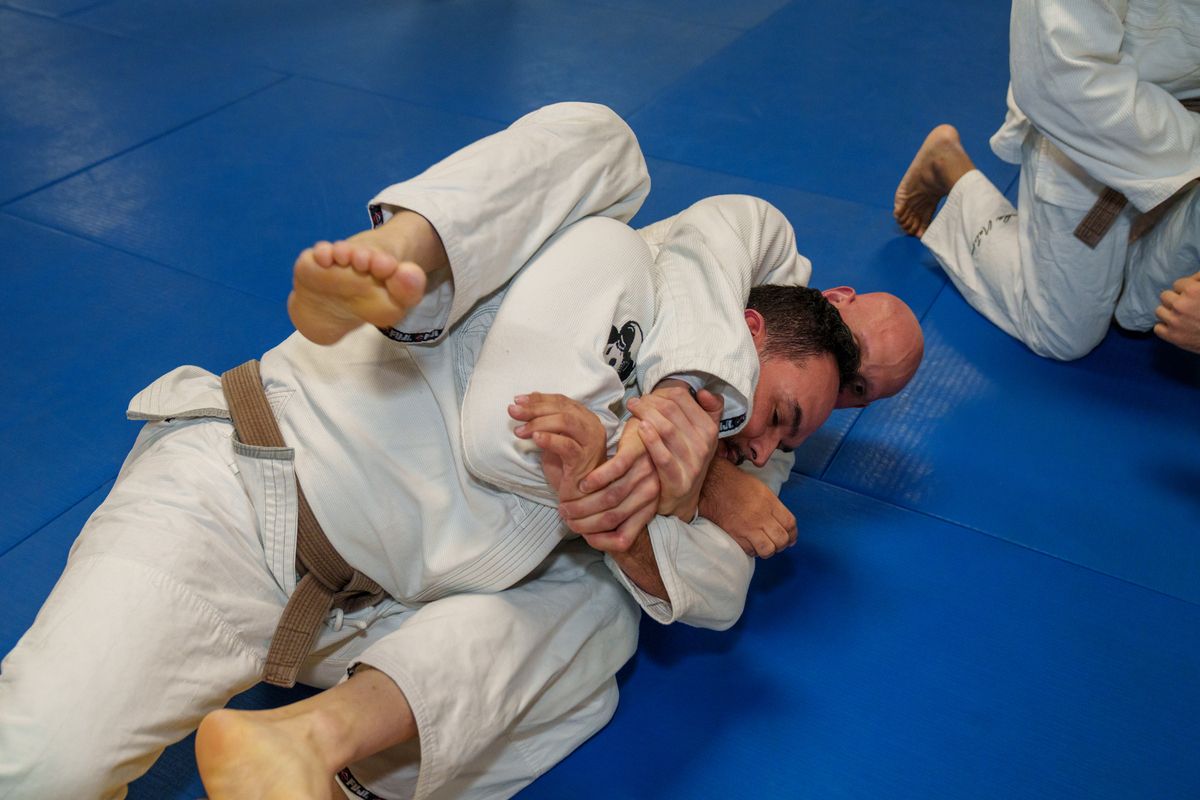
Once you can escape, we teach control. Positions like closed guard, half guard, side control, and back control are not just sport ideas, they are ways to stabilize a situation. Control also gives you time to assess what is happening and make decisions that match reality.
Standing skills matter in 2025, and we train them
One of the biggest trends in 2025 is a renewed emphasis on wrestling fundamentals in brazilian jiu jitsu. That shift makes sense for self-defense: most encounters start standing, and you need to understand clinches, trips, and takedown mechanics even if your preference is to disengage.
We teach you how to manage distance, how to pummel for underhooks, how to break grips, and how to avoid getting driven backward. And when the moment calls for it, we show you takedowns that work for regular adults, not just lifelong athletes.
Here is what that standing focus typically includes in our curriculum:
• Clinch safety skills like hand fighting, head position, and underhook control so you can stop being moved around
• High-percentage takedowns such as simple doubles and body lock finishes, taught with a safety-first landing approach
• Takedown defense fundamentals including sprawl mechanics and angle changes so you are not surprised by forward pressure
• Wall and corner awareness so you can keep your feet under you when space is limited
• Technical stand-ups and disengagement drills so you can create separation and leave instead of staying tangled up
Those details are a major reason people searching for brazilian jiu jitsu in Bethlehem PA often end up wanting something more practical than what they expected. We keep it realistic, and we keep it repeatable.
Practical submissions and the real goal behind them
Self-defense training is not about collecting submissions. Still, submissions matter because they teach control, leverage, and how to end a situation decisively when there is no safe exit. Competition data in 2025 shows elite submission-focused athletes winning at extremely high rates, with a large share of finishes coming from fundamentals like triangles and armbars, plus back attacks like the bow and arrow choke in gi contexts. The underlying lesson is not “be a competitor,” it is “fundamentals under pressure work.”
We teach submissions as part of a bigger framework:
Chokes as control tools
Chokes are effective because they do not rely on strength the same way strikes often do. In training, we use them to reinforce position first, then finishing mechanics second. You learn to apply pressure with your whole body, not just your arms.
Joint locks as leverage education
Armbars and similar locks teach you how to isolate a limb and control the opponent’s posture. Even if you never want to apply a lock outside the gym, the skill of isolating and controlling translates directly into safer escapes and better positional control.
No-gi and “less grip, more reality”
No-gi training often creates faster transitions because you cannot stall with fabric grips. That pace is useful for self-defense because real life does not hand you sleeve grips. We balance gi and no-gi so you develop adaptable control, not a one-environment skill set.
What adult beginners in Bethlehem should expect in class
A lot of adults hesitate because they picture a room full of advanced students trying to win every round. That is not how we run our floor. We coach fundamentals, we scale intensity, and we keep the learning curve sane. You will sweat, you will feel awkward at first, and you will also improve quicker than you think if you show up consistently.
When you join an adult jiu jitsu in Bethlehem PA program, you should expect structure. We typically build classes around a skill theme, drill it with feedback, and then add controlled live rounds so you learn timing. We also keep safety at the center: tapping early, protecting training partners, and learning how to move without panic.
If you are worried about fitness, start anyway. Jiu jitsu builds fitness in a way that is hard to fake. Your coordination and conditioning improve because you are solving real movement problems, not just counting reps.
A simple progression we use to build real skill
We like to keep the journey clear, especially for self-defense focused students. You do not need to master everything at once. You need the next right layer.
1. Learn survival positions and frames so you can protect yourself when things go wrong
2. Add escapes and stand-ups so you can reset and leave when possible
3. Build top control and pin escapes so you can manage pressure safely
4. Develop a small set of takedowns and clinch skills so you are not guessing while standing
5. Connect a few submissions to strong positions so you understand how control becomes an exit
That progression also helps you avoid the common beginner trap of chasing complicated moves before you can hold balance and posture.
Training smart: recovery, data, and staying consistent
Another 2025 trend we see across the sport is more data-driven training. People use wearables like Whoop or Oura to track sleep, recovery, and strain so they can train hard without burning out. You do not need a device to train intelligently, but the mindset is useful: consistency beats hero workouts.
We encourage you to pay attention to a few basics:
Sleep is your superpower, even if it is not glamorous. Hydration and simple mobility work keep your joints happier. And if your body feels beat up, we adjust intensity. Our goal is for you to train next week, not just survive today.
Women’s self-defense and an inclusive training environment
Female participation in brazilian jiu jitsu continues to rise, including more women coaching and training in women-focused settings. Self-defense is a major reason many women start, and we take that seriously by creating a learning environment where you can ask questions, set boundaries, and build skill without unnecessary intensity.
We also teach context. Self-defense is not only technique, it is awareness, distance management, and knowing when to leave early. On the mat, you get the physical piece: how to escape holds, how to stand up safely, and how to control someone who is larger without relying on strength.
Gear basics: what you need and what you can wait on
You do not need a garage full of equipment to start. If you are training in the gi, you will want a well-fitting gi that does not restrict movement. In 2025, lightweight and more sustainable gis are trending, and we see demand spikes in late summer and again near November. If you are training no-gi, a rashguard and grappling shorts are enough.
What matters most is comfort and safety. Trim nails, wash your gear, and do not overthink it. We would rather you show up with simple equipment and a learning mindset than delay for weeks trying to buy the “perfect” setup.
Take the Next Step
Building self-defense skill is not about fear, it is about readiness. When you train jiu jitsu the right way, you learn how to manage the standing phase, protect yourself on the ground, and make calm decisions under pressure, all while improving fitness and confidence as a byproduct.
If you are looking for brazilian jiu jitsu in Bethlehem PA with a practical, adult-friendly approach, we have built our training at Inverted Gear Academy around fundamentals, safety, and real-world applicability. You bring the willingness to learn, and we will guide the process one class at a time.
Turn what you learned here into hands-on training by starting Brazilian Jiu-Jitsu at Inverted Gear Academy.